


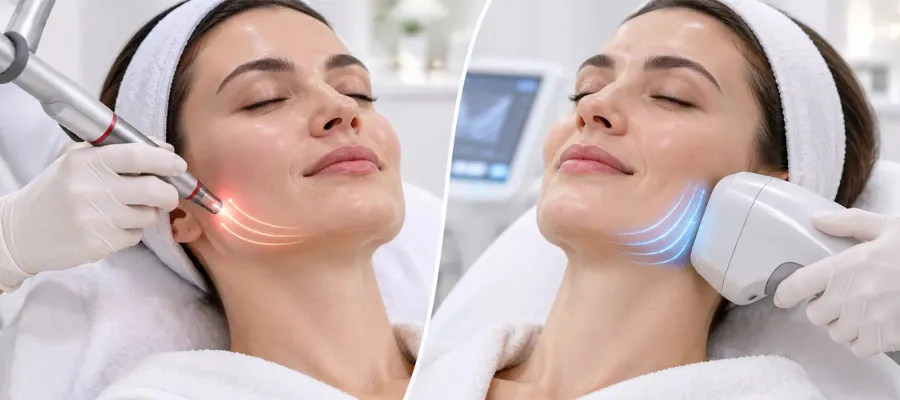
The main difference between Fotona 4D and HIFU is the type of energy used to tighten the tissues. Fotona 4D uses two different laser wavelengths to target both the skin surface and deeper tissues. HIFU, on the other hand, uses focused ultrasound energy to generate heat at specific depths and promote tissue tightening. Both treatments support collagen production without requiring surgical incisions, but they do not address exactly the same signs of facial aging.
Fine lines, reduced jawline definition, and sagging cheeks do not always develop for the same reasons. Sometimes the skin surface loses its natural radiance, while in other cases, laxity in the supporting facial tissues becomes more noticeable. Understanding this distinction helps determine whether Fotona 4D or HIFU is the more appropriate treatment.
What Is Fotona 4D and How Does It Work?
Fotona 4D facial rejuvenation is a treatment that combines Er:YAG and Nd:YAG lasers across four different modes. Laser energy is applied to various areas, starting from the tissues inside the mouth and extending to the outer surface of the face. Controlled heating supports the remodeling of collagen fibers, while the superficial laser stage aims to renew the skin’s texture.
An important feature of this approach is that it does not focus exclusively on skin laxity. Fine wrinkles, lines around the mouth, enlarged pores, and uneven skin texture can also be addressed during treatment. However, laser treatment cannot replace lost bone or fat tissue. When facial volume loss is significant, skin tightening alone may not be sufficient.
What Is HIFU and How Does It Tighten the Face?
HIFU stands for high-intensity focused ultrasound. Sound waves pass through the skin surface and create small thermal points at targeted tissue depths. This controlled heating effect aims to promote gradual tissue remodeling and achieve a firmer appearance. Facial treatment applicators commonly include options with focal depths of 1.5, 3, and 4.5 millimeters.
Deeper applicators can target the SMAS, one of the supporting layers of the face, in suitable areas. However, the depth of this layer is not the same throughout the face. Facial anatomy and the thickness of fatty tissue must be considered during HIFU treatment. Applying energy at the same depth across the entire face is not an appropriate approach.
What Are the Differences Between Fotona 4D and HIFU?
The differences between these treatments extend beyond how energy reaches the skin. The sensation of heat during treatment, targeted areas, effects on the skin surface, and the time required for results to develop should also be considered.
| Comparison | Fotona 4D | HIFU |
|---|---|---|
| Energy type | Er:YAG and Nd:YAG lasers | Focused ultrasound |
| Target area | Skin surface, connective tissue, and intraoral tissues | Supporting tissues at specific depths |
| Primary purpose | Skin rejuvenation and tightening | Tissue tightening and lifting effect |
| Intraoral treatment | Included in the standard protocol | Not included in standard facial treatment |
| Skin surface peeling | May occur during the superficial laser stage | Generally not expected |
| Development of results | Over several weeks and months | Over several weeks and months |
| Number of sessions | Generally 2-4 sessions | Usually a single session |
What Are the Four Stages of Fotona 4D?
The number four in Fotona 4D refers to the four separate laser modes used during the procedure. Each stage has a different purpose, and combining them allows a wider range of skin concerns to be addressed.
- SmoothLiftin: Uses an intraoral Er:YAG laser to tighten tissues inside the cheeks and reduce the appearance of lines around the mouth.
- FRAC3: Supports tissue renewal by creating small, controlled thermal zones within the skin using an Nd:YAG laser.
- PIANO: Provides controlled heating across a larger tissue area using a long-pulse Nd:YAG laser.
- SupErficial: Uses an Er:YAG laser to perform gentle superficial peeling, aiming to improve skin texture and the appearance of fine lines.
Further details about these modes are available on the Fotona 4D treatment page. The intensity of the superficial peeling stage should be carefully planned, particularly for skin prone to pigmentation.
Is Fotona 4D or HIFU More Effective for Facial Sagging?
Both treatments can be considered for mild to moderate facial laxity. Because HIFU targets tissues at specific depths, it may be suitable for improving jawline definition and addressing lower facial sagging. Fotona 4D offers an alternative when improving skin quality alongside tissue tightening is also a priority.
However, strong clinical evidence directly comparing these two treatments remains limited. It cannot be concluded that HIFU is better for every type of facial sagging or that Fotona 4D provides greater tightening in every situation. Both procedures have limitations when significant excess skin is present. Results comparable to surgical facelift surgery should not be expected.
Which Treatment Is Better for Fine Lines and Enlarged Pores?
When facial laxity is accompanied by fine lines, dullness, and uneven skin texture, the superficial laser stage of Fotona 4D may help address these concerns. The primary purpose of HIFU is not to exfoliate the skin or correct surface pigmentation. Collagen remodeling may soften some fine lines, but this effect is not the same as direct laser skin resurfacing.
For deep acne scars and significant texture irregularities, fractional laser treatment may be considered as a separate option. Understanding that not every wrinkle or skin irregularity occurs at the same depth helps prevent unnecessary treatments.
Which Treatment Is Better for Different Facial Areas?
The face consists of several tissue layers. Skin thickness and fat distribution differ across the cheeks, forehead, mouth area, and beneath the chin. Therefore, treatment planning should consider the specific characteristics of each facial region.
| Area or Concern | Fotona 4D | HIFU |
|---|---|---|
| Mild cheek sagging | Skin tightening and improved skin quality | Targeted tissue tightening |
| Lines around the mouth | Intraoral and external laser treatment | Not a primary treatment area |
| Jawline | Support for mild skin laxity | Lifting effect in suitable tissues |
| Double chin area | May be considered for tightening | May be applied depending on tissue structure |
| Enlarged pores and fine surface lines | Supports skin resurfacing | Limited and indirect effect |
The eye area requires special attention. Treatments specifically designed for this region, such as SmoothEye laser, can be planned according to its delicate structure, with appropriate eye protection.
How Many Fotona 4D and HIFU Sessions Are Needed?
Fotona 4D is generally planned as a series of 2-4 sessions performed several weeks apart. HIFU is often performed in a single session, with the need for additional treatment assessed after monitoring the results. A single-session procedure does not mean that HIFU is more powerful, just as multiple sessions do not guarantee longer-lasting results.
Because collagen remodeling takes time, unnecessary repeat treatments should be avoided during the early stages. For individuals who have previously undergone energy-based treatments, the date and area of the earlier procedure should be known.
What Is the Recovery Process Like After Fotona 4D and HIFU?
Mild redness, a sensation of warmth, dryness, and superficial peeling may occur after Fotona 4D. Following HIFU, tenderness, mild swelling, or temporary tingling may develop. Most people can return to their daily activities within a short period, but this does not mean that either treatment is free from potential side effects.
| Recovery Period | Fotona 4D | HIFU |
|---|---|---|
| First day | Redness and a sensation of warmth | Tenderness and mild swelling |
| First week | Dryness or mild peeling may occur | Sensitivity to touch may continue |
| 1-3 months | Gradual tissue renewal | Skin tightening becomes more noticeable |
| 3-6 months | Collagen remodeling may continue | Results may continue to develop |
When Do Fotona 4D and HIFU Results Become Visible?
A mild improvement in firmness may be noticeable shortly after either treatment. However, the initial changes seen in the mirror immediately after the procedure do not represent the final results. Collagen production and connective tissue remodeling are natural processes that take several weeks or even months.
After Fotona 4D, improvements in the skin surface may become visible before the tightening effects. Following HIFU, improvements in facial contours generally become more noticeable over the next two or three months. Comparing photographs taken under the same lighting conditions and from the same angle provides a more reliable way to assess results.
When Should Fotona 4D or HIFU Treatment Be Postponed?
The condition of the skin and overall health should be assessed before treatment. Certain circumstances may require postponing the procedure or selecting an alternative method:
- Open wounds, active infections, or cold sores in the treatment area.
- Considering energy-based aesthetic treatments during pregnancy.
- Recent dermal filler injections, thread lifts, or facial surgery.
- Implants or electronic medical devices within the treatment area.
- Sunburn or significant tanning before laser treatment.
- Advanced facial volume loss or very thin fatty tissue, particularly when considering HIFU.
Not all of these conditions present the same level of concern for both treatments. The pre-treatment assessment should consider the technology being used and the anatomical structure of the face.
What Are the Side Effects of Fotona 4D and HIFU?
Laser treatments may rarely cause burns, pigmentation changes, infections, or scarring. HIFU may cause temporary numbness, bruising, and pain, as well as rare complications such as nerve damage, burns, or unwanted fat loss. In particularly thin faces, unwanted volume reduction may create a more hollow appearance.
Medical evaluation should not be delayed if severe pain occurs during treatment or if blistering, increasing pain, or changes in facial movements develop afterward. Increasing treatment intensity does not always lead to better results.
Can Fotona 4D and HIFU Be Combined?
When both superficial skin changes and facial laxity are present, different technologies may be included in the same treatment plan. However, performing both procedures on the same day or in immediate succession is not necessary. The overall thermal exposure, skin sensitivity, and previous treatments should be taken into account.
Fotona EndoTight, which delivers laser energy beneath the skin through a thin optical fiber, is a minimally invasive procedure that differs from both methods. The fact that a technology reaches deeper tissues does not mean that it is necessary for every face.
How Are Fotona 4D and HIFU Prices Determined?
Fotona 4D and HIFU prices are determined by considering the size of the treatment area, the number of sessions, and the scope of the treatment plan. A procedure targeting only the lower face does not have the same scope as a program covering both the face and neck. When comparing prices, the total treatment process should be considered alongside the cost of an individual session.
Frequently Asked Questions
Which Lasts Longer, Fotona 4D or HIFU?
Neither treatment provides permanent, lifelong results. The natural aging process of the skin continues. The duration of the effects is related to the initial degree of skin laxity and the changes that occur in facial tissues over time.
Are Fotona 4D and HIFU Painful?
A sensation of warmth and mild stinging may occur during Fotona 4D treatment. During HIFU, more intense but brief discomfort may be experienced, particularly in areas close to the bones. The level of discomfort is related to the energy settings and individual sensitivity.
Can You Go Out in the Sun After Fotona 4D and HIFU?
Sun protection is important after both treatments. Skin that has undergone superficial laser peeling may be particularly sensitive. Using broad-spectrum sunscreen and avoiding direct sun exposure can help reduce the risk of pigmentation changes.
Do Fotona 4D and HIFU Melt Facial Fat?
The primary purpose of Fotona 4D is skin rejuvenation and tightening rather than fat reduction. HIFU, however, may affect fatty tissue depending on the applicator and energy settings used. Preserving natural facial volume is just as important as tissue tightening in facial rejuvenation.